Posts

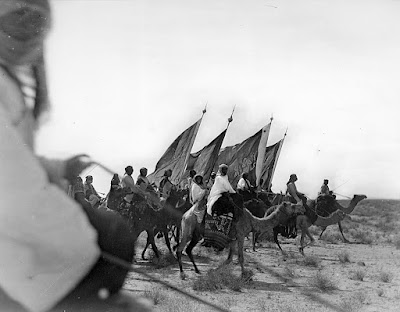
Formation of Modern Saudi Arabia - History and Significance
Image
Modern-day Saudi Arabia is a vast country, established in 1932 after the unification of the majority areas of the Arabian peninsular under the rule of the al-Saud family. Modern Saudi Arabia is also the Third Saudi State because Saudis established two previous states in the 18 th and 19 th centuries. Saudis gained influence through the Salafi ideology of Islam, which is quite similar to the  Puritan faith of the Christian religion. Brief History Muhammad bin Abdul Wahhab (1703-1792) was a famous preacher and religious scholar of Najd (central Arabia). The basis of his teachings is on strict Islamic beliefs, where the emphasis is on the propagation of T awheed (monotheism) and rejection of shirk (polytheism), bidah (innovations in Islam), and supplication from anyone except Allah. Ibn-e-Saud's family accepted h is religious ideology, and later both families allied. Under an agreement, Ibn Abdul Wahhab accepted the political supremacy of the al-Saud family in their captured area...

Juan Ponce de Leon - The First European to Reach the USA

Image
Juan Ponce de Leon was a Spanish explorer and nobleman who also became the first Governor of Puerto Rico under the Spanish Empire. He was the first European to reach Florida (now in the USA), which was also the initial exploration of the mainland USA. Early Life Juan Ponce was born in 1474 in the now-Spanish province of Valladolid. During his youth, he took part in the fights against the Muslim rule of Granada during the re-conquest of Spain.  Juan Ponce was the first governor of Puerto Rico Arrival in the Americas After the re-conquest of Spain in 1492, the chance of a military expedition in Spain ended for Juan Ponce. Therefore, he decided to go abroad to test his luck. He joined Christopher Columbus for his second voyage to the New World in 1493, along with 1200 men. A fter visiting several islands, their fleet reached the final destination of the Caribbean island of Hispaniola (now the  Dominican Republic and Haiti ). The Tainos (indigenous people of Hispaniola...

Ancient Greek Philosophers - Their Role in Modern Philosophy

Ancient Greek Philosophy started in the 6 th Century BC and continued till the Ancient Greek period, which later vastly affected the Hellenistic period, Classical Islamic Philosophy, and European Renaissance. There are two main periods of Greek Philosophy. The first is pre-Socratic Philosophy,  while the other is Classical Greek Philosophy. Famous Greek Philosophers and their philosophies are mentioned below according to these two periods. Pre-Socratic Philosophers Pre-Socratic Philosophy is the Greek Philosophy before the famous Greek philosopher Socrates. These philosophers were the first ones who asked rational questions about things like the creation of this universe and the reality of everything while refusing the previous mythological definitions. They were also the pioneers of scientific and mathematical study by introducing paradoxes and problems. Thales According to Aristotle,   Thales (624-546 BC) was the first Greek philosopher. He was born in Miletus ...

Alexander the Great - The Greatest Greek Ruler

Alexander III of Macedon was the king of Ancient Greece . Due to his great successes and occupation of a large empire, he is famous as Alexander the Great. During his 13 years of reign, he conquered Egypt, Persia, and a large part of Asia and North Africa. He is known as one of the greatest military generals in human history. Early Life Alexander was born on 20 th July 356 BC in Pella (then the capital of the Macedonian kingdom and now in Greece). In his childhood, Alexander learned the traits of the noble youth of Macedon, including reading, horse-riding, hunting, and fighting. At 13, Philip appointed the great scholar Aristotle as his tutor. Alexander learned morals, philosophy, medicine, logic, religion, etc. from Aristotle. His later victories were positively affected by the teachings of Aristotle. Alexander’s victories started at 16 when he crushed the rebellion in Thrace . In 338 BC, Alexander took part in the Battle of Chaeronea against the southern Greek city-states of...

Ancient Rome - From Rise to Divide

Ancient Rome was one of the earliest civilizations in Europe, centered around the Italian Peninsula. It rose from a small settlement along the Tiber River, and grew into one of history’s most powerful empires  within a few centuries. However, the significance of the Roman Empire diminished after its   division into two parts in the 4 th Century AD. Alongside  Ancient Greece , the civilization of Ancient Rome shaped the  law, government, architecture, language, and culture in ways still felt today. T he se two ancient civilizations largely influenced the views of the  Renaissance in Europe during the 14 th Century. There are four eras of this ancient civilization: the Roman Kingdom, the Roman Republic, the Roman Empire, and the division of the Roman Empire. Roman Kingdom According to legend,  twin brothers Romulus and Remus  founded the city of Rome in 753 BCE. Later, Romulus became the first king of the Roman Kingdom. Seven mon...

Ancient Greece - From City-States to the Hellenistic Period and Its Fall

Image
Ancient Greece was one of the earliest civilizations in the world and the first civilization in Europe. It is often regarded as the cradle of Western civilization. Ancient Greece continuously influences the modern world through its ideas in philosophy, politics, art, and science. The story of Ancient Greece is both remarkable and complex. It starts with the rise of independent city-states, moves through the sweeping conquests of Alexander the Great and eventually declines under Roman dominance. City-States (Polis) Greek cities suffered destruction and abandonment during the Dark Ages (1180-800 BC). Around the 8th century BCE, Greece recovered from the “Greek Dark Ages” into a period of growth and innovation. But unlike unified empires such as Egypt or Persia, Greece developed as a collection of independent city-states , or poleis . Each polis was a self-governing community with its own political systems, military, currency  and culture. Athens : The city is known for its democrat...

Muslim Migration to Madinah - Reasons and Importance

In 622 AD, Prophet Muhammad (PBUH) and his followers migrated from Makkah to Madinah to save themselves from the atrocities of the Quraysh of Makkah. This migration ( Hijra ) later resulted in the formation of the  First Islamic City State in Madinah, which paved the way for the  Conquest of Makkah and gaining strength of Islam in the whole of the Arabian Peninsular during the life of Muhammad (PBUH). Background of Migration The revelation of the Holy Qur’an started in 610 AD, and Muhammad (PBUH) publically declared his prophethood in 613 AD. The majority of the idol-worshipping people of Makkah, the Quraysh tribe, totally refused the oneness of God, the prophethood of Muhammad (PBUH), and his teachings and did anything possible to eliminate this new religion before it could develop its roots. Both rich and poor Muslims faced the cruelty and atrocities of Quraysh, while converted slaves suffered severe punishments from their masters.  In 613 and 615 AD, several Musl...